Digital Tools That Reduce Workplace Distractions
In a working world defined by constant connectivity, the ability to focus deeply on meaningful tasks has become one of the most valuable professional skills. Yet, for freelancers, remote workers, founders, and employees alike, the modern digital environment can feel engineered for interruption rather than concentration. Notifications, chat messages, emails, social feeds, and endless browser tabs compete for attention, often fragmenting the workday into short, shallow bursts of activity. Against this backdrop, a new generation of digital tools is emerging to help individuals and teams reclaim their focus, and funky fresh platforms such as CreateWork are placing this challenge at the center of how they support independent and distributed professionals.
This article explores how thoughtfully selected and configured digital tools can reduce workplace distractions, drawing on current research, recent product developments, and practical experience from remote-first and hybrid organizations. It also considers how freelancers and remote teams can integrate these tools into sustainable workflows that support productivity, well-being, and long-term career growth.
The Science of Distraction in the Digital Workplace
Cognitive scientists and organizational researchers have spent the last decade examining how digital interruptions affect performance. Studies summarized by Harvard Business Review and American Psychological Association indicate that frequent task switching imposes a measurable "switching cost" on the brain, with even brief interruptions leading to longer periods required to regain full concentration. Research from UC Irvine has suggested that it can take more than 20 minutes to fully refocus after a disruption, and while estimates vary across studies, the broad conclusion is consistent: fragmented attention reduces both the quality and the efficiency of knowledge work.
Neuroscience research published in journals accessible through PubMed shows that constant novelty and notification checking can reinforce reward-seeking behaviors, making it harder for individuals to sustain deep work without external prompts. At the same time, the rise of remote and hybrid work, accelerated by global events earlier in the decade, has pushed workers to rely more heavily on digital communication tools, intensifying the risk of overload. For many professionals in the United States, Europe, and across Asia-Pacific, communication platforms that were initially adopted to enable flexibility have, without careful design, contributed to a culture of perpetual partial attention.
This context is critical for the audience here, which serves freelancers, remote professionals, and early-stage founders who must manage their own time and attention with relatively less structural support than traditional office workers. Understanding the cognitive impact of distraction is the first step toward selecting tools that do more than simply block websites; the most effective solutions align with how human attention actually works.
Categories of Digital Tools that Reduce Distractions
Digital tools that support focus can be grouped into several overlapping categories, each addressing a different dimension of distraction. Rather than seeking a single "silver bullet" app, successful professionals often combine multiple types of tools within a coherent workflow, something CreateWork emphasizes across its resources on productivity tools and remote work.
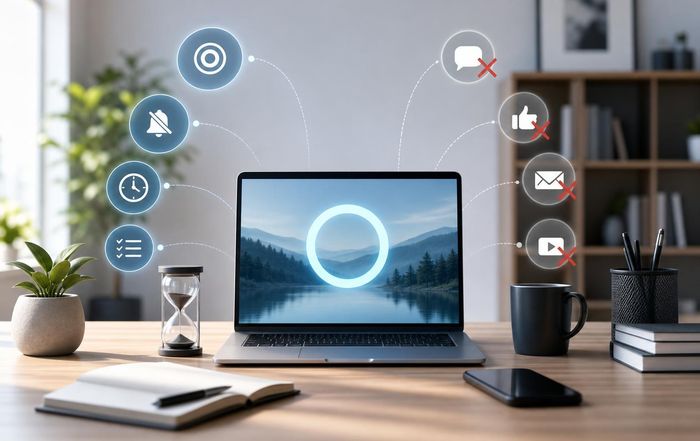
Focus-supporting tools generally fall into the following broad categories: website and app blockers; notification and communication managers; timeboxing and deep work schedulers; task and project management systems; AI-based assistants and automation; and digital well-being and analytics platforms. Within each category, there are now mature products with global user bases, as well as emerging solutions that integrate artificial intelligence to provide more context-aware support.
Website and App Blockers: Guardrails for Attention
Website and app blockers create intentional friction between the worker and distracting digital environments such as social media, news feeds, or entertainment platforms. Tools like Freedom, Cold Turkey, and FocusMe allow users to define lists of websites or applications that will be inaccessible during predefined focus sessions. Many of these tools run on multiple platforms and can synchronize blocking rules across devices, which is crucial for freelancers and remote workers who often switch between laptops, tablets, and phones.
Research discussed by The New York Times and BBC Worklife suggests that self-imposed digital constraints can meaningfully reduce time spent on habitual distractions, especially when combined with clear work goals and schedules. However, blockers work best as part of a broader system rather than as a standalone solution; if underlying workflows remain chaotic or communication expectations are unclear, workers may simply find new ways to distract themselves.
For independent professionals using CreateWork to design sustainable careers, app blockers can function as a simple but powerful boundary-setting tool, especially during client work, creative sprints, or strategic planning. When paired with the income management and planning guidance in CreateWork's money and finance resources, these tools help ensure that high-value tasks receive uninterrupted attention.
Notification Management and Communication Hygiene
A major source of digital distraction is not the content of work itself but the constant stream of notifications from email, messaging platforms, collaboration tools, and social networks. As organizations have shifted toward remote and hybrid structures, tools such as Slack, Microsoft Teams, and Zoom have become essential, but they can also create environments where workers feel compelled to respond instantly to every ping.
Modern operating systems and communication platforms now offer increasingly granular notification controls. Features such as "Do Not Disturb" modes, focus filters, and priority notifications in Apple's macOS and iOS, Google's Android, and Microsoft's Windows allow users to specify which apps or contacts can interrupt them during certain times. Communication tools themselves, including Slack and Teams, have expanded options for status messages, scheduled notification pauses, and channel-specific alerts.
Guidance from organizations like Digital Wellness Institute and research compiled by Pew Research Center emphasize that effective use of these features requires not only individual configuration but also shared norms. Remote teams that agree on response-time expectations, preferred channels for urgent issues, and quiet hours across time zones tend to experience fewer burnout symptoms and higher sustained productivity.
For readers of CreateWork, especially freelancers working with multiple clients across regions from North America to Europe and Asia, mastering notification management is essential. Establishing clear availability windows in communication tools, using status messages to signal deep work periods, and disabling non-essential alerts can dramatically reduce context switching. The CreateWork guide on remote work practices reinforces how such habits can be integrated into client agreements and team charters.
Timeboxing, Deep Work Schedulers, and Digital Rituals
Beyond blocking and muting, a growing class of tools is designed to structure time intentionally around focused work. Timeboxing platforms such as Motion, Sunsama, and Akiflow integrate calendars, tasks, and scheduling algorithms to allocate specific time blocks for deep work, meetings, and administrative tasks. Many of these tools now incorporate AI to suggest optimal schedules based on deadlines and energy patterns.
The "Pomodoro" technique, which alternates short bursts of focused work with brief breaks, has inspired numerous timer apps and browser extensions, including Marinara Timer, Forest, and Pomofocus. Some tools, like Forest, combine gamification and digital well-being by rewarding users for staying off their phones during focus sessions, a concept that has gained attention in coverage by The Guardian and other international outlets.
Academic and professional communities have increasingly recognized the value of such structured approaches. Studies referenced by Stanford University and MIT Sloan Management Review highlight that deliberate timeboxing can reduce decision fatigue and create predictable rhythms that support deep work. For freelancers and early-stage founders who navigate a mix of billable work, business development, and learning, these tools help ensure that high-impact tasks are not crowded out by reactive communication.
Within the CreateWork ecosystem, where many users are designing portfolio careers or launching ventures, integrating timeboxing tools with the strategic frameworks in the business startup guide can be especially effective. Deep work sessions can be reserved for product development, client strategy, or financial planning, while shallow work is batched into specific windows to limit fragmentation.
Task and Project Management Systems that Minimize Overload
Task and project management tools are ubiquitous, but their design can either reduce or amplify distraction. Platforms such as Asana, Trello, ClickUp, and Notion enable teams to centralize tasks, documents, and communication, reducing the need to chase information across email threads and chat logs. When configured thoughtfully, these tools can act as a single source of truth, allowing workers to focus on the next most important action rather than juggling multiple informal to-do lists.
However, experts writing for MIT Technology Review and Wired have noted that overloaded project boards and constant notification triggers within these platforms can themselves become sources of distraction. The key is to use them as structured repositories rather than as real-time communication streams, with clear conventions for when comments, mentions, and status updates are truly necessary.
For the global community served by CreateWork, task and project systems can be aligned with the platform's broader guidance on business operations and employment transitions. Freelancers can use lightweight boards to track client deliverables, invoices, and marketing activities, while remote teams can standardize workflows across time zones, reducing the need for synchronous check-ins. When combined with calendar-based timeboxing, these tools ensure that priorities are visible but not constantly intruding.
AI Assistants and Automation as Shields Against Distraction
Artificial intelligence, once primarily associated with cutting-edge research labs, has become deeply embedded in mainstream productivity tools. AI-powered assistants now help summarize emails, draft responses, generate meeting notes, and automate repetitive tasks, which can significantly reduce the cognitive load associated with administrative work. Products such as Google Workspace's AI features, Microsoft Copilot, and integrations in tools like Notion AI and Grammarly exemplify this trend.
By handling routine tasks and information retrieval, AI tools can free workers to concentrate on creative, strategic, or relationship-focused work. For example, automated transcription and summary tools integrated into video conferencing platforms reduce the need for manual note-taking, while AI-driven email triage can surface the most important messages and defer or archive the rest. Industry analysis from McKinsey & Company and Deloitte suggests that such automation can meaningfully increase productivity when implemented thoughtfully, though the exact magnitude of impact varies widely by role and sector.
At the same time, AI systems can introduce new forms of distraction if they generate excessive suggestions, notifications, or low-quality outputs that require constant oversight. Responsible implementation involves calibrating these tools, setting clear boundaries for automated actions, and maintaining human judgment over key decisions. CreateWork addresses these nuances in its dedicated resources on AI and automation, helping freelancers and entrepreneurs understand where AI can genuinely support focus and where it may create additional noise.
For professionals across regions such as the United States, United Kingdom, Germany, Singapore, and beyond, AI-driven automation also intersects with broader questions about the future of work, skills, and income. By using AI to offload low-value tasks, individuals can invest more time in upskilling, strategic thinking, and building resilient business models, themes that CreateWork explores in its upskilling and economy content.
Digital Well-Being and Analytics Platforms
Another important class of tools focuses on measuring and improving digital habits. Platforms like RescueTime, Timing, Toggl Track, and built-in features such as Apple's Screen Time and Google's Digital Wellbeing provide detailed analytics on how time is spent across applications, websites, and devices. These insights can reveal patterns of distraction that might otherwise go unnoticed, such as frequent context switching between messaging apps and work tools or late-night email checking that erodes rest.
Reports from organizations including World Health Organization and OECD have underscored the links between overwork, stress, and reduced productivity, especially in knowledge-intensive roles. Digital well-being tools, when combined with clear boundaries and supportive organizational cultures, can help mitigate these risks by highlighting when workloads or habits are becoming unsustainable.
For the audience of CreateWork, which includes many self-employed individuals without formal HR support, such tools are especially valuable. By tracking focus time, breaks, and non-work digital activity, freelancers and remote workers can make data-informed adjustments to their schedules and environments. This complements the lifestyle and well-being insights available through CreateWork's lifestyle and finance sections, where sustainable work patterns are linked to long-term financial and personal health.
Integrating Tools into Coherent Workflows
The most sophisticated digital tools will not reduce distraction if they are adopted piecemeal without an underlying strategy. Effective focus systems combine multiple elements: clear goals, time-blocked schedules, streamlined communication norms, selective use of blockers, and regular reflection on what is working. For distributed teams, these systems must also take into account cultural differences, time zones, and varying access to technology across regions from North America and Europe to Asia, Africa, and South America.
Thought leaders in productivity and organizational design, including those featured by Cal Newport's blog and Futurum Research, often emphasize the importance of "minimalist" tool stacks. This approach involves choosing a small number of well-integrated tools and mastering them deeply rather than constantly chasing new apps. For example, a freelancer might rely on a single project management tool, one timeboxing calendar, a focused set of communication channels, and one analytics platform, with AI features layered in where they clearly reduce friction.
CreateWork encourages this systems-based thinking across its platform, from the freelancers hub to the broader technology insights and guide resources. By viewing digital tools not as isolated products but as components of a personal or organizational operating system, professionals can create environments where distraction is the exception rather than the norm.
Remote Work, Global Teams, and Cultural Nuances
The rise of remote work has fundamentally changed how distractions manifest. In traditional offices, interruptions often came from colleagues dropping by desks or impromptu meetings. In remote and hybrid settings, digital channels have replaced physical proximity, bringing both flexibility and new forms of overload. For workers in countries such as Canada, Australia, India, and Brazil, remote arrangements have opened access to global opportunities but also introduced challenges related to asynchronous collaboration, blurred home-work boundaries, and constant connectivity.
Reports from International Labour Organization and Eurofound indicate that remote workers often experience both higher autonomy and higher risk of overwork, depending on how work is organized. Digital tools that reduce distractions can therefore play a dual role: protecting focus during working hours and helping to enforce boundaries outside them. Features such as scheduled email sending, delayed notifications, and explicit "offline" statuses allow workers across time zones to collaborate without expecting immediate responses at all hours.
Platforms like CreateWork are particularly attuned to these dynamics, as their communities span continents and cultures. By curating guidance on remote work best practices and highlighting tools that support asynchronous collaboration, CreateWork helps freelancers and remote teams design workflows that respect both productivity and personal time. This is especially important in regions where labor regulations, cultural norms, and infrastructure differ significantly, from Scandinavia to Southeast Asia and from South Africa to New Zealand.
Financial and Business Implications of Reduced Distractions
While the personal benefits of reduced distraction-less stress, more satisfaction, better work-life balance-are significant, there are also clear financial and business implications. For freelancers and independent consultants, the ability to complete high-quality work efficiently directly affects income, client retention, and the capacity to take on additional projects. For startups and small businesses, focused execution often determines whether limited resources are converted into sustainable growth.
Economic analyses by organizations like World Economic Forum and Brookings Institution have linked productivity improvements to broader economic resilience, particularly in knowledge-driven sectors. Although it is difficult to isolate the specific contribution of distraction-reducing tools, case studies from technology firms and remote-first companies suggest that coherent focus strategies can meaningfully improve project delivery times and reduce burnout-related turnover.
Within our ecosystem, these themes intersect with content on money management, business building, and creative careers. By integrating digital tools that support focus into financial planning and business strategy, professionals can align their daily habits with long-term goals, whether that means stabilizing freelance income, scaling a remote agency, or developing intellectual property.
Building a Personal Focus Ecosystem with CreateWork
For many professionals navigating the evolving landscape of technology, employment, and entrepreneurship in 2026, the central challenge is not a lack of tools but an abundance of choice. The key is to design a personal ecosystem that reflects individual goals, working styles, and constraints, while drawing on proven principles from cognitive science and organizational research.
A practical approach often begins with reflection: identifying the most common sources of distraction, whether they are social media, messaging apps, email, internal worries, or environmental factors. From there, individuals can select a small set of tools across the categories discussed-blockers, notification managers, timeboxing schedulers, task systems, AI assistants, and analytics platforms-and experiment with configurations over several weeks. Regular reviews, informed by time-tracking data and subjective experience, allow for gradual refinement.
CreateWork is positioned as a companion in this process, offering interconnected resources that span technology, finance, business, and lifestyle. Through its main portal, individual newsletter subscribers, or website visitors can explore detailed guidance on remote work setups, AI adoption, productivity tools, and career transitions, all framed with an emphasis on practical, trustworthy, and positive insight. By combining these resources with carefully chosen digital tools, freelancers, remote employees, founders, and creative professionals can build working lives where focus is protected, distractions are managed, and meaningful work has the space it needs to flourish.
